






root@node-c2:~# cd /academy
ACADEMY
Learn by breaching. Real Linux commands, real tools and real CVEs, inside a simulation where mistakes cost nothing.
WHY IT TEACHES
NOT AN AUTOHACKER. A TRAINING GROUND.
Most hacking games hide the work behind a progress bar. NODE: PROTOCOL hands you a real terminal. The Linux commands, including pipes, behave exactly like the real ones, and the vulnerabilities you exploit are real, published CVEs.
That means the habits you build while playing, reading logs, chaining commands and thinking like an attacker, carry over to a real machine.
SKILL TRACKS
WHAT YOU LEARN
Linux command line
Navigate file systems, read logs, chain commands with pipes and work like a sysadmin. The syntax is the real thing, so it carries straight over to any Linux machine.
Networking & recon
Learn how hosts, ports and services fit together, map networks and understand why reconnaissance comes before everything else.
Vulnerabilities & CVEs
See how real, published vulnerabilities are researched and matched to the software they affect, across 106 real CVEs.
Operating systems
Windows 7 and 10, FreeBSD, Debian-based Linux, CentOS, AIX and Cisco IOS, legacy systems from Solaris 8 and IRIX to OpenVMS, NetWare and AS/400, plus banking and ATM shells: see how differently real infrastructure behaves.
OPSEC & forensics
Every action leaves a trace and investigators follow it. You learn what logs record and why defenders rely on them.
Red team concepts
Command-and-control, phishing awareness and botnets, explained through gameplay so you understand how attacks are organized.
Mobile & SIGINT
Why cell networks, SIM cards and SMS-based MFA are weak points, and what that means for protecting your own accounts.
OSINT & social engineering
How public information and human trust become part of an attack surface, and how to recognize it.
BUILT-IN GUIDANCE
LEARNING INSIDE THE GAME
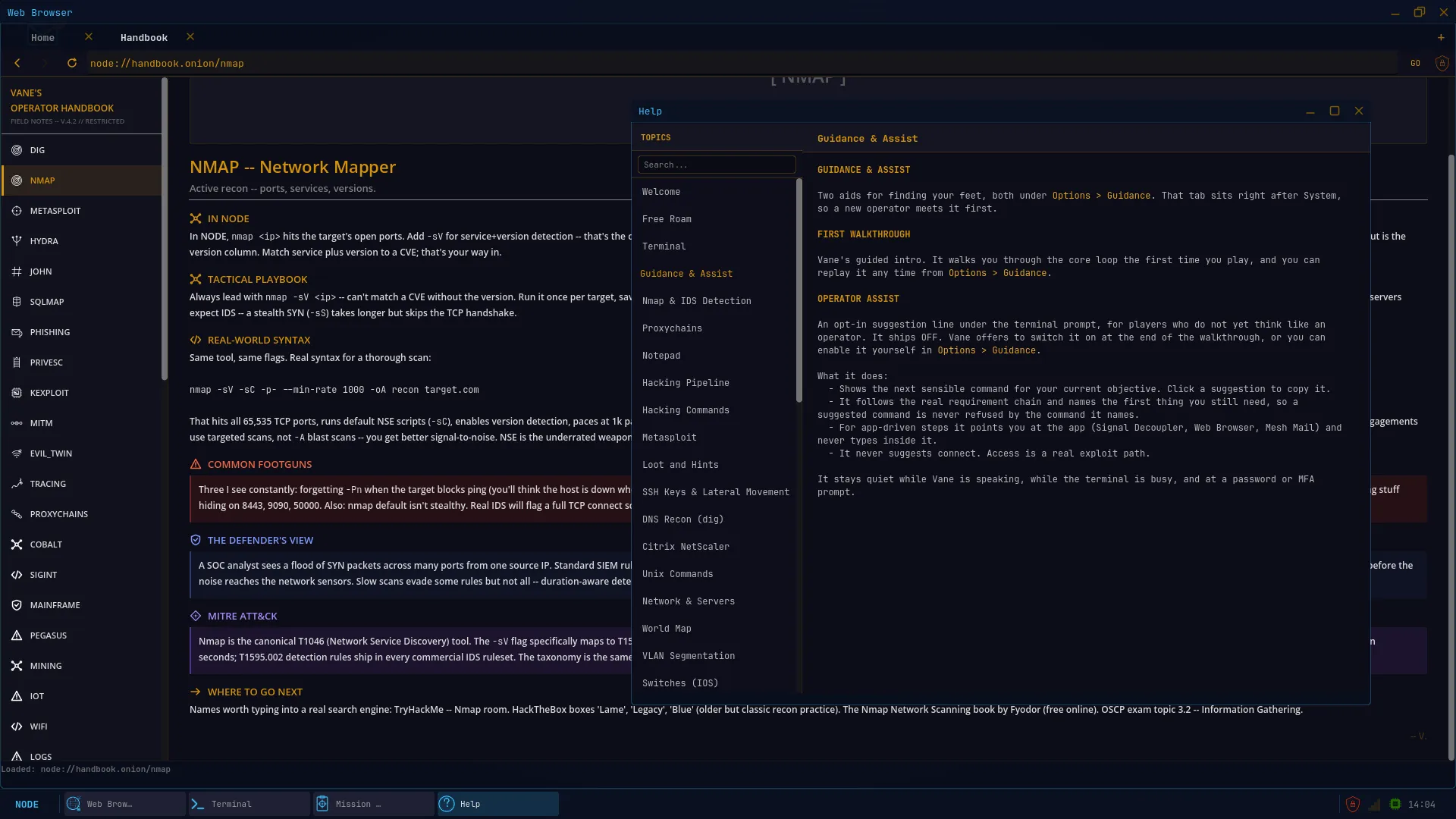
Operator Manual
An in-game manual documents the tools you use: what they do, how they work and when to use them. You learn the concept, not just the button.
Guidance from Vane
Your handler walks you through your first breach and keeps guiding you, so you can start with zero Linux or security experience.
Safe to fail
Everything happens inside a simulated network. Mistakes cost you in-game heat, not a real-world incident, so you can experiment freely.
INDUSTRY FRAMEWORK
MAPPED TO MITRE ATT&CK
MITRE ATT&CK is the framework security teams use to describe attacker behavior. NODE: PROTOCOL covers all 15 of its Enterprise tactics.
| ID | TACTIC | IN NODE: PROTOCOL |
|---|---|---|
| TA0043 | Reconnaissance | Mapping domains, hosts and services before a job |
| TA0042 | Resource Development | Building infrastructure: servers, botnets, safehouses |
| TA0001 | Initial Access | Getting a first foothold through a known vulnerability |
| TA0002 | Execution | Running exploits and payloads on a target |
| TA0003 | Persistence | Keeping access with backdoors and botnet implants |
| TA0004 | Privilege Escalation | Going from a user account to full control of a system |
| TA0005 | Stealth | Blending in: valid accounts, process injection, clearing your command history |
| TA0112 | Defense Impairment | Killing antivirus and EDR, wiping system logs, changing firewall rules |
| TA0006 | Credential Access | Passwords, keys and wallets as targets |
| TA0007 | Discovery | Mapping a network from the inside after the first foothold |
| TA0008 | Lateral Movement | Pivoting through LANs from one host to the next |
| TA0009 | Collection | Gathering data with keyloggers and beacons |
| TA0011 | Command and Control | Running operations through a C2 framework |
| TA0010 | Exfiltration | Mission objectives built around stolen data |
| TA0040 | Impact | DDoS and world-state consequences of your actions |
CAREER PATHS
FROM GAME TO CAREER
The game builds familiarity with real tools, Linux and attacker thinking. It is not a certification, but it gives you a head start on the roles and exams below.
SOC analyst
Reading logs, spotting traces and understanding attacker behavior.
Penetration tester
Recon, vulnerabilities and the structure of an engagement.
Red team operator
How real operations are organized, from infrastructure to C2.
Linux sysadmin
Fluency on the command line, pipes and system logs.
- OverTheWire: Free Linux and security wargames, starting with Bandit.
- TryHackMe: Guided, browser-based labs for beginners and up.
- Hack The Box: Hands-on labs and legal practice targets for every level.
We are opening a pilot for classrooms, bootcamps and security teams. Request pilot access and tell us who you are and how you would use NODE: PROTOCOL.
NODE: PROTOCOL is a simulation: every target is fictional. In the real world, only test systems you own or have written permission to test. Unauthorized access is a crime almost everywhere.
FAQ
QUESTIONS
Can a hacking game teach real skills?
Yes, within real limits, and that honesty is the point. The terminal in NODE: PROTOCOL is not a scripted prop: the Linux commands behave like the real ones, pipes included, so a chain like ps aux | grep ssh | wc -l does exactly what it does on a real machine, and the output stays coherent the way a live system is, where a process eating the CPU shows up in top, in w, and in the load average. On top of that you run the genuine attack methodology, reconnaissance then exploitation then privilege escalation then cleanup, using real tools such as nmap, Metasploit, sqlmap, hydra, john, and linpeas against authentic Linux, Windows, FreeBSD, AIX, and mobile systems. What transfers is the part that matters most: command fluency, the shape of a real engagement, and the instinct to think about logs and traces. It will not hand you a certificate or replace time on real authorized infrastructure, but the habits you build here are the same ones you use on a real terminal.
Do I need Linux or hacking experience?
No. The game assumes you are starting cold and teaches as you play. It opens with an in-world tutorial from your handler that walks you through your first scan, exploit, and log clean; a 47-topic Operator Handbook explains the concepts behind each tool; and an optional hint rail can suggest the exact next command when you are stuck. That rail is off by default, so it never talks over you until you switch it on. You learn the terminal by using it, not by reading a manual first. At the same time the depth is real: experienced players will find authentic Cisco IOS, AIX mainframes, SWIFT banking terminals, and cellular SIGINT waiting, so the game grows with you instead of capping out once the basics click.
Will NODE: PROTOCOL get me a cybersecurity job?
On its own, no, and anyone who tells you a game alone will is selling something. What it does is build a real foundation and keep you motivated while you build it: terminal fluency, the end-to-end attack methodology, an instinct for OPSEC and trace analysis, and hands-on familiarity with the tools and vulnerability classes you will meet again in the field. That foundation makes the formal path easier, whether that is a certification like Security+, CEH, or OSCP, lab platforms, or real authorized practice, because you arrive already thinking like an operator instead of memorizing from scratch. Treat it as a serious on-ramp and a place to keep your fundamentals sharp, paired with the certs and lab time employers actually look for.
Is it legal?
Yes, completely. Everything happens inside a self-contained simulation. There are no real networks, no real IP addresses, and no real systems touched at any point. The entire world lives on your own machine, and even multiplayer connects players to each other, never to an outside target, so nothing you do in the game reaches the internet or any outside infrastructure. The one thing worth saying plainly is that the skills are dual-use. Running these techniques against real systems you do not own or have written permission to test is a crime in most countries, no matter where you learned them. NODE: PROTOCOL is the legal place to practice; taking it to a real network requires authorization, whether that is a pentest engagement, a CTF platform, or your own lab.
Can I use it in a classroom or for team training?
Yes, and it is well suited to it. Because the whole thing is a sandbox with no real infrastructure behind it, there is no legal exposure and nothing a student can accidentally break, yet the tools and methodology are the real ones, so the lesson sticks. The built-in tutorial and Operator Handbook give you structured onboarding for a class, and the competitive WARGAMES mode is built for groups: crews of up to six run head-to-head Capture the Flag matches, challenge codes let an instructor hand every team the identical scenario, and it runs on an isolated LAN with no internet required, which suits a lab room or a live event. Use it to teach fundamentals, drive engagement, and run team exercises alongside your formal curriculum, not in place of the hands-on labs that certification prep needs.
Which real tools and commands will I use?
The real ones. Reconnaissance with nmap, scan, and searchsploit; exploitation through a Metasploit console, sqlmap, and hydra; password cracking with john; privilege escalation with linpeas, winpeas, sudo, and kernel exploits; pivoting with ssh, proxychains, and tunnels. Over a hundred terminal commands in all, including 20 real Unix utilities that pipe together exactly like a real shell. Learn it here and you can type it on a real box.
How is this different from HackTheBox, TryHackMe, or a CTF?
Those hand you an isolated box to solve. NODE: PROTOCOL drops you into a living world: roughly 250 gateways with about 3,000 machines behind them, an economy, rival hackers, and investigators who trace you while you work. The skills are the same, but here they sit inside consequence. You are not solving a lab, you are running an operation and covering your tracks.
Does it teach defense and OPSEC, or only how to break in?
Both. Every action leaves logs in two separate systems and feeds a trace that walks back toward you, so you learn what defenders see and how to stay quiet. You work around real blue-team tooling along the way: SIEM log forwarders, EDR agents, and antivirus that catches a careless payload. Understanding the defender is built into getting in.